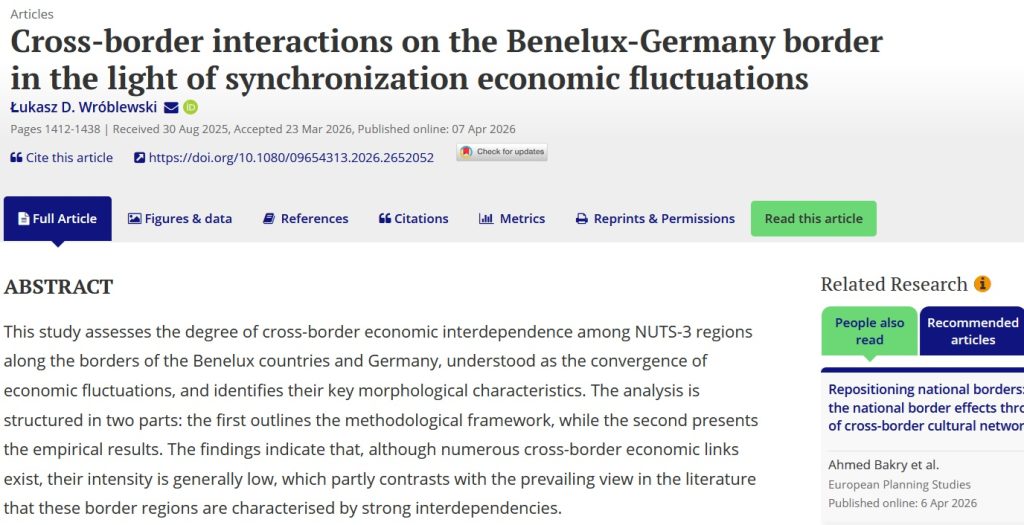
We recommend Dr Łukasz Wróblewski’s article entitled “Cross-border interactions on the Benelux-Germany border in the light of synchronization economic fluctuations.”
Contemporary Europe is often portrayed as a borderless continent where border regions form cohesive and dynamically developing economic areas. The latest study by one of our researchers puts this vision to the test by analysing regions located at the intersection of Belgium, the Netherlands, Luxembourg and Germany. Dr Łukasz Wróblewski examined the extent to which the economies of these regions are interconnected by investigating the synchronization of business cycle fluctuations.
Key findings of the study:
- The actual intensity of cross-border economic linkages is relatively low.
- Despite the absence of physical borders and their participation in the single market, regional economies continue to exhibit a high degree of autonomy. Their economic “pulse” is more closely aligned with national than cross-border dynamics.
- The study identified specific structural features—referred to as the morphological characteristics of regions—that determine the extent to which they are susceptible to the influence of neighbouring regions across the border.
- These findings have important implications for regional policy planning in the European Union.
- Removing legal and physical barriers alone is not sufficient to create an integrated regional market. Policymakers need to examine the structural causes of limited integration more closely. Understanding how economic fluctuations spread—or fail to spread—allows governments to prepare more effectively for local financial crises and assess whether problems affecting one region are likely to spill over across the border.
The findings are presented in the article “Cross-border interactions on the Benelux-Germany border in the light of synchronization economic fluctuations,” published in European Planning Studies.